
Pulpitis Treatment in Miami: Reversible vs Irreversible
Pulpitis treatment in Miami starts with one question: is the inflammation reversible or irreversible? Reversible pulpitis is treated by removing the cause, usually decay or a leaking filling. Irreversible pulpitis needs root canal therapy or, in select cases, a pulpotomy. Advanced Endodontic Group makes that call with cold testing and CBCT imaging at two Miami offices, often the same day.
Why See an Endodontist for Pulpitis in Miami?
Pulpitis is a diagnosis about the nerve inside the tooth, and the treatment depends entirely on getting that diagnosis right. Endodontists are the specialists in pulp diagnosis. We use standardized cold testing, electric pulp testing, percussion, and CBCT imaging to decide whether the pulp can recover, needs a root canal, or has already died and is forming an abscess.
Getting it wrong costs patients in both directions. A reversible case treated with a root canal loses a healthy nerve for nothing. An irreversible case treated with a filling keeps hurting and progresses to infection. Our practice is limited to endodontics, led by Dr. Ingrid Epelman-Dorra with over 25 years of focused experience, and both offices run surgical microscopes and CBCT.
Pain that wakes you at night or lingers after cold is a same-day problem. Both offices hold emergency slots for pulpitis, and most patients leave the first visit out of pain.
What Is the Difference Between Reversible and Irreversible Pulpitis?
Reversible pulpitis is mild inflammation of the dental pulp that can heal once the irritant is removed; pain is brief, triggered by cold or sweets, and stops within seconds. Irreversible pulpitis is inflammation the pulp cannot recover from; pain lingers for 30 seconds or more after cold, comes on spontaneously, and often worsens at night or with heat.
| Feature | Reversible pulpitis | Irreversible pulpitis |
|---|---|---|
| Response to cold | Sharp, brief, stops within seconds | Sharp, lingers 30 seconds or longer |
| Spontaneous pain | No | Yes, often throbbing |
| Night pain | Uncommon | Common, may wake you |
| Response to heat | Usually none | Often makes it worse |
| Pain on biting | No | Sometimes, once inflammation reaches the root tip |
| Treatment | Remove the cause, protect the pulp | Root canal therapy or pulpotomy |
The AAE also distinguishes symptomatic from asymptomatic irreversible pulpitis. A tooth can be irreversibly inflamed without hurting, which is why a deep cavity found on an X-ray may still need a root canal. Pulp necrosis, the stage after irreversible pulpitis, is when the nerve dies; the tooth may go quiet before an abscess forms.
What Causes Pulpitis?
Pulpitis is caused by anything that lets bacteria or irritation reach the pulp: deep decay, a cracked tooth, a large or leaking filling, repeated dental work on the same tooth, trauma from a blow, or grinding that wears through enamel. Decay is the leading cause. The pulp swells inside a rigid chamber, and that pressure is the pain.
Pulpitis after a new filling or crown is common and often reversible. Sensitivity that fades over two to four weeks is expected. Sensitivity that lingers, gets worse, or turns into spontaneous pain is not, and it needs testing. A cracked tooth is a frequent hidden cause when there is no visible decay.
How Is Pulpitis Diagnosed?
We diagnose pulpitis by reproducing your symptoms under controlled conditions. A cold stimulus is applied to the suspect tooth and its neighbors and the response is timed. An electric pulp test checks whether the nerve responds at all. Tapping and biting tests show whether inflammation has reached the root tip. X-rays and CBCT reveal decay depth, cracks, and bone changes.
Pulp pain is often referred: an upper molar can feel like a lower one, and a back tooth can ache toward the ear or temple. Testing several teeth is how we avoid treating the wrong one. See our differential diagnosis page for how we separate tooth pain from sinus, jaw joint, and nerve pain.
How Is Pulpitis Treated?
Reversible pulpitis is treated by removing the cause: decay is cleaned out or a leaking filling replaced, then the pulp is protected and watched. Irreversible pulpitis is treated with root canal therapy, which removes the inflamed pulp and seals the canals. For select teeth, a full pulpotomy that removes only the crown portion of the pulp is an option.
Root canal therapy remains the standard for irreversible pulpitis, with success above 95% according to the American Association of Endodontists. Vital pulp therapy is a newer alternative for mature teeth with irreversible pulpitis, supported by an AAE position statement in 2021. A 2024 meta-analysis in PLOS ONE found an 86.7% overall pulpotomy success rate, with 82.4% for teeth diagnosed with irreversible pulpitis versus 92% for reversible cases. A 2024 ten-year cohort in Scientific Reports reported 91.6% success for vital pulp therapy after carious exposure.
"Teeth diagnosed with symptomatic irreversible pulpitis can be treated successfully with a full pulpotomy."Vital Pulp Therapy in Permanent Teeth: A Systematic Review and Meta-Analyses, 2025
We discuss both options when a tooth qualifies. Root canal therapy is the predictable choice for most adult molars; pulpotomy can make sense for young patients with immature roots. Either way, the tooth is sealed the same visit and returned to your dentist for a crown or filling.
What Can You Do for Pulpitis Pain Before Your Appointment?
Ibuprofen works well for pulpitis pain because it reduces the inflammation itself; acetaminophen can be added or used instead if you cannot take ibuprofen. Avoid hot foods and drinks, chew on the other side, and sleep with your head raised. None of this treats the cause. Call for a same-day appointment.
Antibiotics do not help pulpitis. The pulp is inflamed, not infected in the way an abscess is, and antibiotics cannot reach it. Current AAE guidance recommends against antibiotics for irreversible pulpitis without swelling. If you were prescribed antibiotics for a toothache and are not better in 48 hours, the tooth needs treatment, not a second course.
How Much Does Pulpitis Treatment Cost in Miami?
Cost depends on the diagnosis. If testing shows reversible pulpitis, the visit is a diagnostic fee and your dentist places the filling. If the pulp is irreversibly inflamed, root canal therapy typically runs $700 to $1,000 for a front tooth and $1,000 to $1,800 for a molar, before the crown.
Most PPO dental plans cover 50 to 80% of endodontic treatment after the deductible. We verify benefits before your visit and offer CareCredit financing. Full pricing is on our root canal cost page.
Where to Get Pulpitis Treatment in Miami
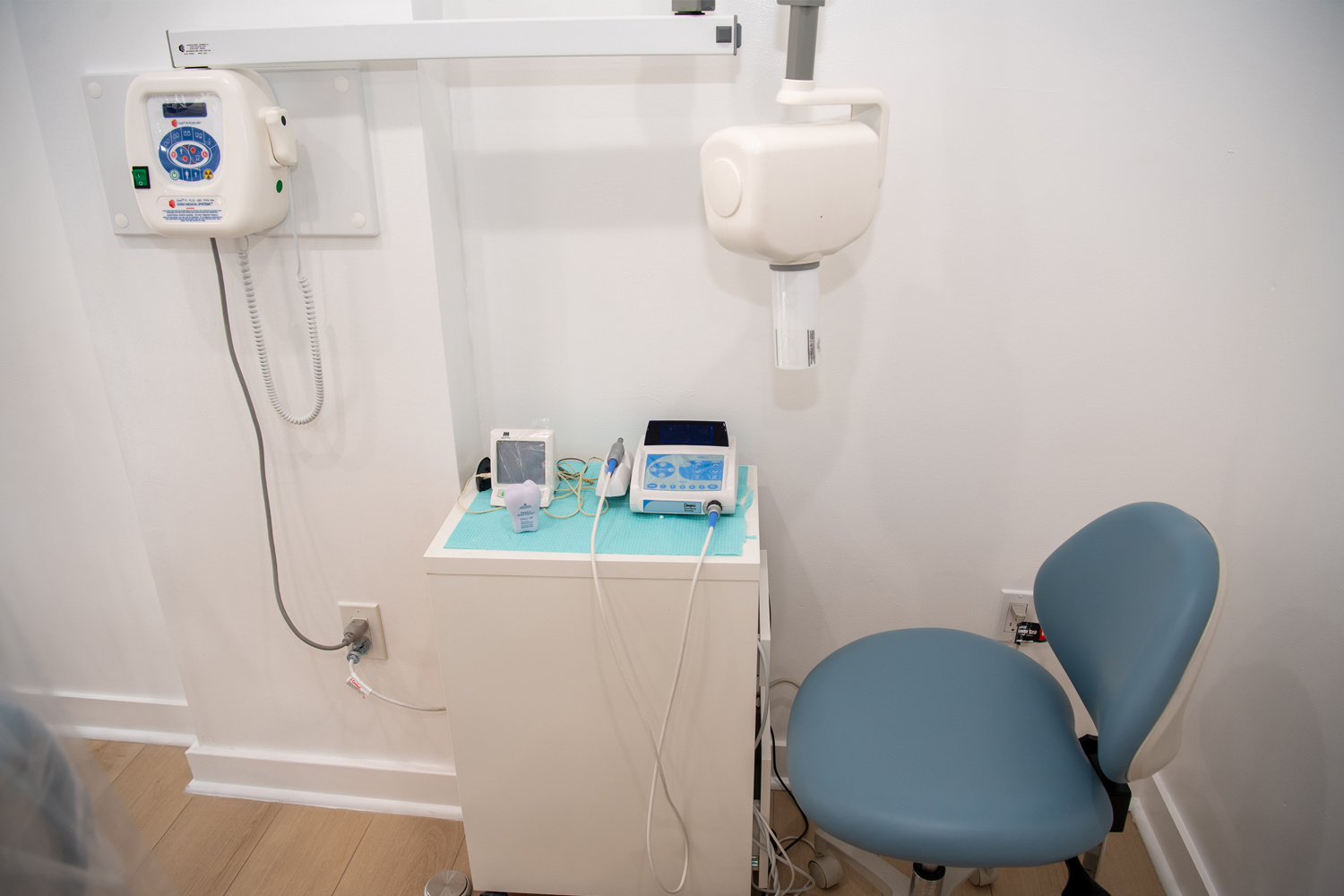
Both offices hold same-day slots for tooth pain and are equipped with surgical microscopes, CBCT 3D imaging, electric pulp testing, and Fotona laser-assisted irrigation. Our team is bilingual in English and Spanish.
Miami Lakes
7975 NW 154th Street, Suite 250
Miami Lakes, FL 33016
Convenient for patients from Hialeah, Doral, Miramar, and Pembroke Pines.
Bay Harbor Islands
1045 Kane Concourse, Suite 204
Bay Harbor Islands, FL 33154
Convenient for patients from Miami Beach, Aventura, Sunny Isles Beach, Surfside, and Coral Gables.
Frequently Asked Questions
-
Reversible pulpitis can settle once the irritant is removed, for example after a cavity is filled or a high filling is adjusted. Irreversible pulpitis does not resolve. The pain may fade when the pulp dies, but the dead tissue then becomes a source of infection and an abscess. Pain going away is not the same as the problem going away.
-
Reversible pulpitis usually improves within two to four weeks of removing the cause. Irreversible pulpitis lasts until the tooth is treated. Without treatment, the acute pain phase can run days to a few weeks before the pulp dies, after which the tooth may be quiet for weeks or months before an abscess develops. The timeline is unpredictable.
-
Symptomatic irreversible pulpitis is one of the more painful dental conditions and is treated as urgent, though it is not life-threatening the way a spreading abscess can be. We reserve same-day slots at both offices for this. If you also have facial swelling, fever, or difficulty swallowing, the infection has moved past the pulp and you should be seen immediately.
-
Not always. Root canal therapy is the standard and the more predictable option for adult teeth. A full pulpotomy, which removes only the inflamed crown portion of the pulp and seals it with a bioceramic material, is supported by the AAE for selected mature teeth and is often preferred for young patients with developing roots. Extraction is the last resort.
-
Lying down raises blood pressure in the head, which increases pressure inside the inflamed pulp chamber. There are also fewer distractions at night, so pain that was tolerable during the day feels worse. Night pain, and pain that wakes you, is a strong indicator of irreversible pulpitis rather than simple sensitivity, and it warrants prompt testing.
-
No. Pulpitis is inflammation inside a closed chamber with a limited blood supply, and antibiotics do not reach or reverse it. The AAE recommends against antibiotics for pulpitis without signs of spreading infection. Antibiotics are appropriate when there is swelling, fever, or swollen lymph nodes, which indicate the infection has moved beyond the tooth. Treatment is what stops pulpitis pain.
-
The pulp dies, and the bacteria that caused the inflammation spread through the root tip into the bone, forming a periapical abscess. That can mean swelling, a gum boil, bone loss around the root, and infection that spreads to the face or neck. A tooth that could have been saved with a root canal may then need surgery or extraction.
Tooth Pain That Lingers or Wakes You?
That is the pattern of irreversible pulpitis. Same-day appointments at both Miami offices.
Schedule Your Appointment



Your best option
We keep fluid communication with the dentists who refer their patients to us, making a team of joint assistance so that the patient is treated efficiently. After the endodontic treatment, the dentist is provided with a detailed report of all the procedures and their results so that they can continue with the dental restoration.
A canal treatment is the last resort before extracting a tooth to keep those teeth whose nerves have been affected. We are specialists in Endodontics, and we count with the best professionals and the latest technologies to assist you. So whether you are a patient or a dentist, Advanced Endodontic Group is the solution you are looking for..